
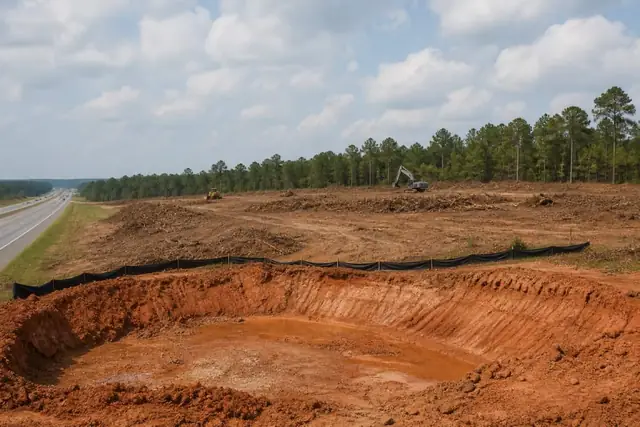

Rose City Land Clearing connects Tyler-area property owners with a local land clearing provider for commercial site clearing across Tyler and nearby East Texas properties.
Commercial clearing is a production stage inside a documented development plan, not a larger version of a backyard brush job.
Tyler-area sites may combine wooded frontage, existing drainage, red sandy upper soils, softer receiving areas, and traffic constraints at the public-road entrance.
The proposal ties clearing limits to current plans and survey control, then separates timber, grubbing, processing, haul-off, erosion controls, and rough access.
A clean handoff leaves the earthwork team known quantities and usable control points rather than mixed piles, disturbed benchmarks, and unprotected exposed soil.
Translate the civil set into a clearing work package
Commercial clearing should follow current survey control and issued plans, with demolition, timber, grubbing, haul-off, erosion controls, access, and rough-grade handoffs separated. For work governed by Tyler, the City of Tyler official site provides current development and permit contacts; projects elsewhere must use the authority responsible for that parcel rather than borrowing Tyler requirements.
Utility coordination begins before production equipment crosses the site. The Railroad Commission of Texas damage-prevention program explains statewide excavation obligations, while the owner, civil team, and utility representatives resolve private systems, abandoned lines, operator meetings, and any conflicts shown on the plans.
Control disturbed acreage and deliver a clean earthwork handoff
Construction stormwater responsibility must be assigned across clearing, earthwork, and vertical construction. The TCEQ construction-stormwater page describes regulated acreage and common-plan coverage, so the work package identifies who installs, inspects, maintains, and repairs controls during each phase.
Mapped soils can inform staging, topsoil separation, and wet-area planning without replacing geotechnical work. The USDA NRCS Web Soil Survey is an early screening source; approved reports and field conditions govern proof rolling, undercut, fill, compaction, and the surface accepted by the earthwork contractor.