
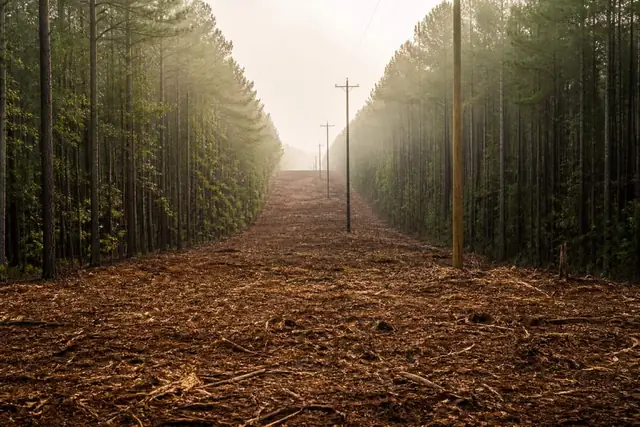

Rose City Land Clearing connects Tyler-area property owners with a local land clearing provider for right-of-way clearing across Tyler and nearby East Texas properties.
Right-of-way clearing is corridor management, where consistent width and asset protection matter more than the number of stems removed.
East Texas easements can cross pine rows, pasture, creek approaches, county roads, and dense yaupon, with poles, markers, gates, and buried facilities sharing the alignment.
Work begins with verified limits, owner or utility requirements, access permissions, locate records, sensitive crossings, disposal instructions, and a plan for maintaining service continuity.
The deliverable may be mowing, selective cutting, mulching, hazard-tree coordination, or debris removal; each item needs an explicit standard and documented boundary.
Work from documented limits and owner standards
A utility or access easement can share space with pipelines, poles, markers, gates, drainage, public roads, and private improvements. The controlling owner or operator must provide current limits, access permissions, vegetation standards, and service-continuity rules. The Railroad Commission pipeline damage-prevention program is the official Texas reference for excavation around underground pipelines and required locate practices.
The desired result may be low mowing, selective cutting, side trimming, mulching, hazard-tree coordination, or restoration of a blocked patrol lane. The Texas A&M Forest Service vegetation-management guide supports matching the method to plant conditions and management objectives rather than treating all woody cover as one removal category.
Protect crossings, adjacent property, and the maintenance handoff
County-road approaches and drainage structures require coordination with the entity responsible for them. The Smith County official site is a current contact starting point for Smith County segments, while city streets, TxDOT frontage, railroad corridors, and private easements may require their own written authorization.
Wet weather can make a cleared alignment inaccessible or spread rutting beyond the approved work strip. National Weather Service Shreveport forecasts assist schedule planning, but the daily go/no-go decision uses actual bearing, crossing protection, matting needs, and the restoration standard recorded in the work package.