
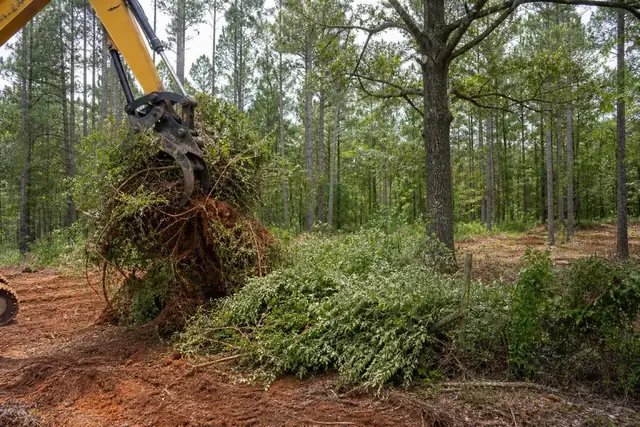

Rose City Land Clearing connects Tyler-area property owners with a local land clearing provider for invasive vegetation removal across Tyler and nearby East Texas properties.
Invasive vegetation work begins with identification because a dense green wall can hold several species with different root systems and return patterns.
Texas A&M Forest Service specifically documents privets and Chinese tallow among East Texas invasive concerns, alongside native brush that may still serve a landowner's goals.
The first pass separates removal targets from keeper plants, chooses mechanical access, and records where cut stumps or resprouts will need monitoring.
Opening the site is immediate; long-term control may involve follow-up cutting or treatment chosen for the species and setting, especially near water or desirable trees.
Confirm the target species before setting a removal method
Chinese privet, Chinese tallow, yaupon, sweetgum, and native screening plants can occupy the same fence corner but call for different decisions. The Texas A&M Forest Service invasive-plants resource identifies important East Texas invaders; the site walk then maps which stems are targets, which vegetation stays, and whether the objective is access, restoration, or simple visual opening.
Mechanical cutting can rapidly recover a lane, yet it may leave roots, seed sources, and resprouting capacity. The Texas A&M Forest Service vegetation-management guidance supports a planned sequence based on species and land goals, so the proposal distinguishes first-pass biomass reduction from any later mowing, monitoring, or treatment by a qualified applicator.
Limit soil disturbance while removing roots and dense thickets
Root pulling can expose more soil than mulching and may not be appropriate beside a bank, drainage path, or keeper-tree root zone. The USDA NRCS Web Soil Survey offers a mapped planning layer for soil variability, but the contractor still evaluates actual slope, moisture, erosion potential, and access before deciding which roots can be extracted safely.
Rain and humidity influence trafficability and how quickly exposed ground needs stabilization. National Weather Service Shreveport forecasts support timing decisions for the Tyler area; they do not substitute for onsite soil checks or justify permanent eradication claims after a single dry-weather pass.