

Rose City Land Clearing connects Tyler-area property owners with a local land clearing provider for grading & site prep across Tyler and nearby East Texas properties.
Grading changes where water travels, so every cut and fill decision has consequences beyond making the surface look level.
Tyler's rolling ground and intense thunderstorm runoff make the low side, outlet, and exposed-soil plan as important as the high point of a pad.
A site walk checks proposed elevations, access, mapped soils, existing drainage, offsite flow, utilities, and the tolerance required by the next trade.
Rough grade, compacted structural fill, final landscape grade, and erosion stabilization are distinct outcomes rather than interchangeable phrases.
Start with drainage intent and verified existing ground
Grading changes where water travels, so the starting walk records high and low points, offsite inflow, existing outlets, structures, septic features, and the elevation needs of the next trade. The USDA NRCS Web Soil Survey helps screen mapped soil properties, but field observations and project design—not map color alone—control excavation, moisture conditioning, and material decisions.
Buried facilities must be resolved before cutting a swale or lowering a pad. The Railroad Commission of Texas damage-prevention program describes excavation and locate obligations in Texas, while the owner identifies private systems such as irrigation, septic, yard lighting, or power beyond the meter that may require separate locating.
Define the grade, compaction, and erosion-control handoff
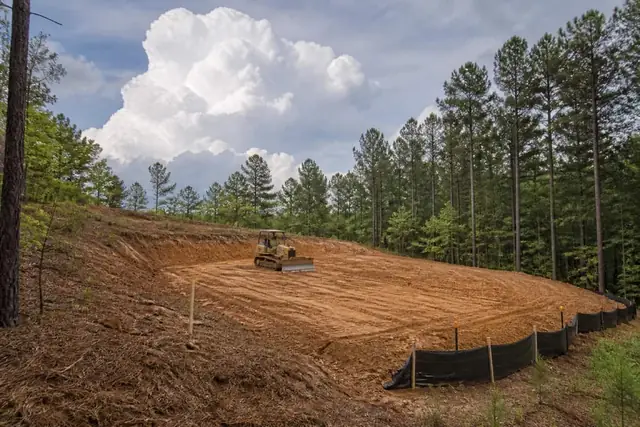
Rough shaping, proof rolling, engineered fill placement, finish grading, and landscape smoothing are not equivalent. The TCEQ construction-stormwater resource explains coverage for qualifying disturbed construction acreage, so a proposal should identify who installs and maintains required controls rather than assuming a dozer pass closes the compliance question.
Exposed red ground can change quickly under a summer storm. National Weather Service Shreveport forecasts help sequence stripping, fill placement, and stabilization around expected weather; acceptance still depends on measured elevations, specified tolerances, and onsite material condition after the work.