
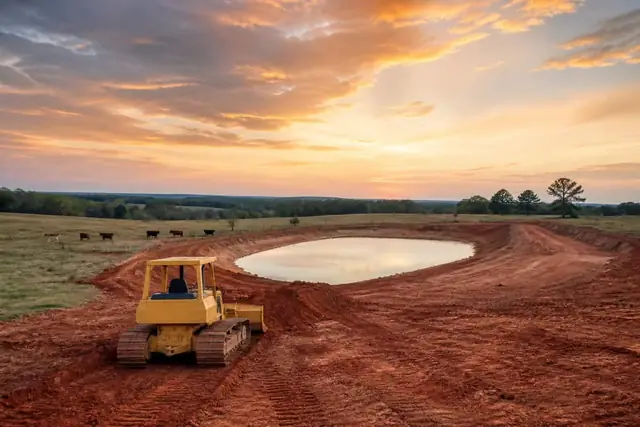
Rose City Land Clearing connects Tyler-area property owners with a local land clearing provider for stock pond dozing across Tyler and nearby East Texas properties.
A durable stock pond depends on its watershed, soils, core, dam geometry, spillway, and safe overflow path before a dozer begins moving material.
Rolling Tyler-area pasture offers natural collection points, but red surface color does not prove the deeper material will seal or support an embankment.
Early planning checks mapped and field soils, drainage area, property lines, underground facilities, wetland or waterway questions, access for equipment, and where excavated material can be placed.
Concept clearing and excavation should follow qualified design guidance for the site; the quote must not promise storage or dam performance from appearance alone.
Evaluate watershed, soils, and embankment needs before excavation
A natural low spot does not prove that a pond will fill, seal, or hold a safe dam. The USDA NRCS Pond 378 standard page describes a formal conservation-practice framework and specifically directs users to state and local criteria; it is a planning reference, not a substitute for qualified site-specific design.
The USDA NRCS Web Soil Survey can screen mapped soil properties and landscape position before field investigation. Test holes, material observations, drainage area, groundwater, seepage risks, and the intended water use still need evaluation before a contractor prices a core trench, borrow area, spillway, or finish grade.
Resolve utilities, disturbed soil, and safe overflow paths
Pond excavation and embankment work can reach well below typical surface-clearing depth. The Railroad Commission of Texas damage-prevention program provides official excavation and locate guidance, while private pipelines, wells, septic systems, and electrical feeds must also be disclosed and investigated for the proposed footprint.
Large disturbed areas or ponds built as part of a broader development may raise construction-stormwater obligations. The TCEQ construction-stormwater page is the state source for coverage thresholds; the owner and design team must also resolve jurisdiction, waterway, dam-safety, and downstream questions that a clearing quote cannot answer.